
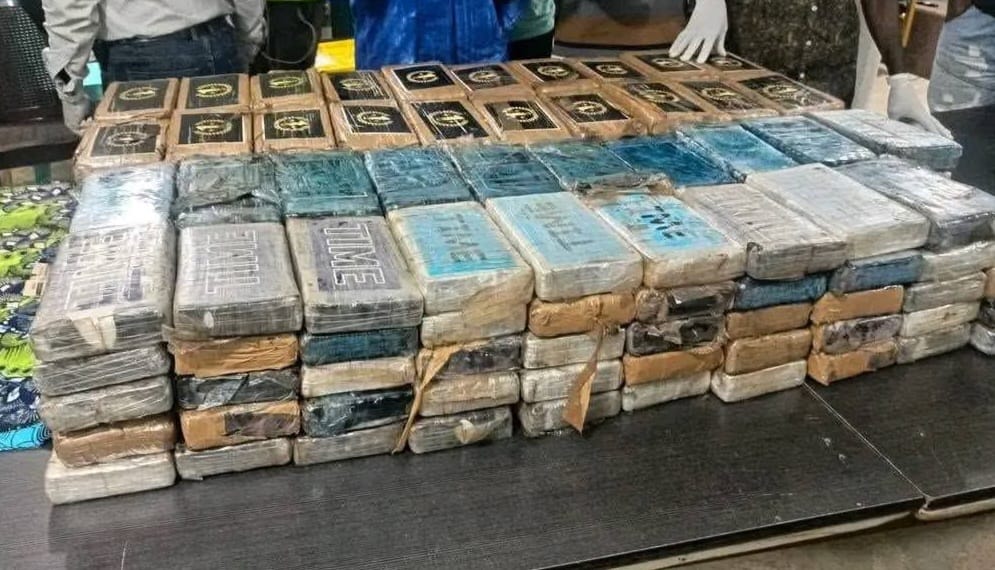
Politics, Security and Investment Interests Collide in US$19.2 Million Cocaine Investigation

4 Mins Read
ADNews-Monrovia,Liberia: The developing situation surrounding the $19.2 million cocaine seizure at the Roberts Air Cargo Centre (RACC) on June 7, 2026, highlights a complex collision between national security enforcement, high-stakes legislative oversight, and private sector investment protection.
The intersection of private capital, domestic political ambitions, and institutional accountability creates significant pressure points for both the ongoing legal process and Liberia’s broader investment climate.
A primary concern within the business and legal communities is the swift politicization of the incident by members of the 55th Legislature before judicial processes have concluded.
High-profile lawmakers, including Senators Momo Cyrus/ Abe Dillon, and Alex Tyler, have maintained rigorous public focus on airport security infrastructure.
Recently, more than 40 members of the House of Representatives adopted a resolution urging the Executive Branch to temporarily suspend the operations of GLS Menzies Aviation Cargo Services and Express Handling Services (EHS). Lawmakers argue this is an essential national security measure to prevent institutional tampering. Critics, however, view it as a premature move to bypass due process and turn a complex criminal investigation into a political referendum on anti-narcotics enforcement.
Adding to the friction is the dual nature of public and private security oversight at Roberts International Airport (RIA). For instance, Senator Momo Cyrus chairs the Senate Committee on Defense, Security, Intelligence, and Veterans Affairs, while his private security firm (SEGAL) provides security services at the airport. This overlap complicates the narrative regarding who bears operational responsibility for security screening lapses at the terminal.
Observers close to the executive ecosystem note that certain factions within the political sphere appear eager to use the crisis to freeze or nullify the existing concession agreement.
This has fueled concerns that special interests inside or adjacent to government may be maneuvering to dismantle GLS’s position in favor of securing new foreign operators.
Amidst the political maneuvering, the fundamental rights and established track records of the private concessionaires remain a central pillar of the debate.
GLS-Menzie have invested millions of dollars into developing the Roberts Air Cargo Centre, modernizing the country’s airfreight capabilities, and establishing structured logistics pipelines.
Prior to the June 7th incident, the facility operated without systemic failures or compliance breaches that would justify terminating or suspending a multi-million-dollar concession agreement.
Investigative details from the Joint Special Investigation indicate that the June 7th consignment passed through standard airport security screening, where it was verified and stamped for export before discrepancies were flagged. This highlights a critical distinction between aviation security protocols (typically governed by state agencies and airport authorities) and ground handling/warehousing operations.
Private individuals are arguing that targeting the logistics handler while ignoring systemic public security vulnerabilities amounts to shifting blame away from compromised state apparatuses.
Allowing political interests to dictate the outcome of an ongoing criminal investigation, or weaponizing executive power to terminate active concession agreements without due process, sets a damaging precedent for Liberia’s economy.
When legitimate corporate investments are subjected to administrative suspension based on unproven allegations, it signals to international markets that sovereign contracts are fragile and subject to shifting political tides.
Large-scale infrastructure developers require regulatory stability. If a private entity can be scapegoated for broader institutional security failures, international capital will view Liberia as a high-risk environment, driving up the cost of borrowing and deterring elite global partners.
Using regulatory enforcement as a tool for political leverage or economic reallocation undermines the rule of law. If private businesses are treated as pawns in domestic political maneuvers, it threatens to permanently destabilize the commercial landscape.
To protect the country’s economic future and national security, the Special Joint Investigation must isolate its findings from legislative rhetoric and political ambitions. Resolving criminal culpability through transparent, evidence-based court proceedings, rather than unilateral contract suspensions, is the only way to safeguard the rule of law and preserve the integrity of Liberia’s investment climate.
Comments are closed.