
RIA Cocaine Shipment Was Never “Accepted”, Emails Suggest
Correspondence between GLS Menzies and Lufthansa Cargo suggests shipment was held over weight discrepancy days before LDEA seizure

4 Mins Read
ADNews-Monrovia,Liberia: The Liberia Daily Observer Newspaper is reporting that new emaild correspondence reviewed is raising fresh questions about the official timeline and chain of custody in the investigation into the 237.6-kilogram cocaine shipment seized at Roberts International Airport, suggesting that the cargo linked to the bust had been flagged over a weight discrepancy days before anti-drug authorities took custody of it.
Credit Daily Observer Newspaper
The emails, dated June 5, reference Air Waybill No. 020-07407960, the same airway bill tied to the cocaine shipment. In one message, a cargo agent requested that the shipment weight be corrected from 200 kilograms to 233.1 kilograms. In another, a GLS Menzies manager advised that the team should “wait on acceptance until this is rectified.”
That phrase may prove crucial.
Confirmed sources at GLS Menzies Group told the Daily Observer that “acceptance” is a standard cargo term meaning that all requirements must be satisfied before a shipment can move to the next operational stage. In this case, he said, the shipment was never accepted because the weight discrepancy had not been resolved.
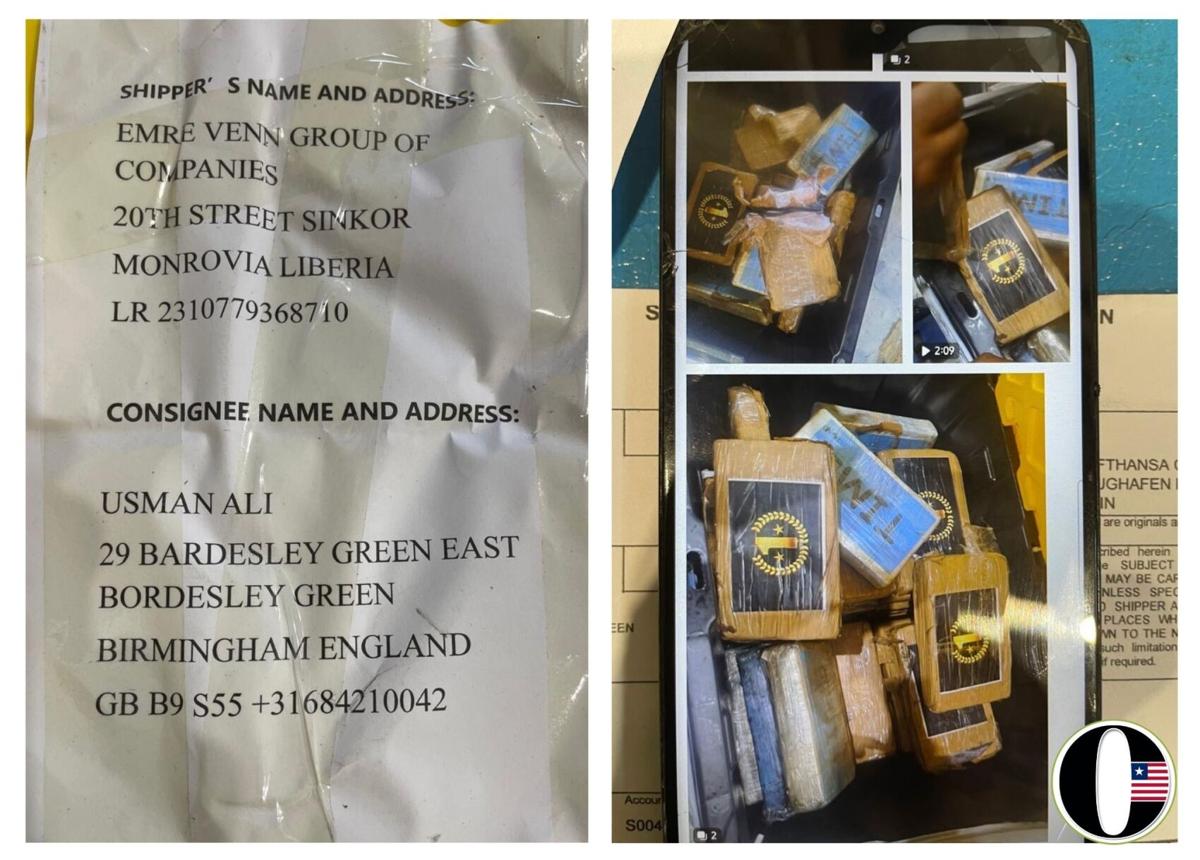
The airway bill reviewed by the Daily Observer lists the shipment as six pieces of “General Cargo,” with a gross weight of 199.8 kilograms and a chargeable weight of 200 kilograms. It names Emre Venn Group of Companies of 20th Street, Sinkor, Monrovia, as shipper, and Usman Ali of Birmingham, England, as consignee.
A separate Consignment Security Declaration shows that the cargo was issued SPX security status on June 5 after X-ray and visual checks by Liberia Airport Authority security personnel.
The new emails suggest that, on the same day the cargo was security-cleared, a weight discrepancy had already emerged.
GLS Menzies later informed the Liberia Drug Enforcement Agency on June 7. The LDEA seized the cocaine on June 8, and the government announced the seizure to the public on June 9.
If that account is confirmed by LDEA records, call logs, CCTV footage, and investigative documents, it could significantly alter public understanding of how the seizure unfolded.
Rather than the cocaine simply being “found at GLS Menzies,” the emerging chronology suggests the shipment may have stalled at the GLS Menzies facility because it had not met acceptance requirements. According to GLS Menzies officials, CCTV footage shows no interaction with the six containers during the period they remained in the facility before they were transferred into LDEA custody.
That claim, if verified by investigators, would narrow the key chain-of-custody question: if no one interacted with the cargo while it was inside the GLS Menzies facility, was the cocaine already concealed inside the shipment before it arrived there?
The timeline also raises a more pointed question: who was pressing for the shipment to move?
According to information provided to the Daily Observer, GLS Menzies officials say threats were issued over the delay caused by the weight discrepancy. Authorities have not publicly confirmed that allegation. But if threats were made, investigators will need to determine who made them, to whom, through what channel, and whether they came from individuals connected to the shipper, freight forwarder, consignee, or other actors in the cargo chain.
The Justice Ministry has named 10 persons of interest in the expanding investigation, including individuals connected to GLS Menzies, Express Handling Services, RIA scanning, airport security, and intelligence operations. Officials have stressed that being named a person of interest is not a finding of guilt.
The Ministry has also said investigators are reviewing cargo manifests, airway bills, surveillance footage, communications, financial records, screening logs, and access-control records as part of a broader effort to determine whether the shipment formed part of a larger criminal network.
The new correspondence adds another layer to that investigation.
It suggests that June 5, not merely June 8 or June 9, may be a critical date in the case. That was the day the cargo was security-cleared, the day the weight discrepancy was documented, and the day GLS Menzies personnel appear to have halted acceptance pending correction.
And did the delay caused by the unresolved weight issue ultimately prevent the cocaine from leaving Liberia?
The LDEA has yet to provide a detailed public timeline explaining when it was first notified, when it first inspected the shipment, and what sequence of events led to the seizure.
Until those questions are answered, the central issue remains unresolved.
Comments are closed.