

5 Mins Read
ADNews-Monrovia, Liberia: The urgent need for a Crime Watch Liberia Night Ambulance has once again come into sharp focus following a disturbing late-night emergency involving a 17-year-old pregnant girl who was reportedly left lying by the roadside in labor for more than an hour before she could receive medical attention.
By Zeze Ballah-Crime Watch Liberia
The incident involving Marthaline Cooper of the Lofa Community in Mount Barclay, on the outskirts of Monrovia, has renewed concerns about the dangers faced by pregnant women who go into labor during the night when emergency transportation is unavailable.
According to information received by the Crime Watch Liberia Program on HOTT FM 107.9, the distress call came at about 3:10 a.m. on Monday, September 14, 2026, when Eric W. Gaye of the Lofa Community contacted the program seeking urgent assistance for the pregnant teenager.
Marthaline had reportedly been brought to the roadside by her sisters while in labor, desperately waiting for transportation to a health facility.
But help did not come immediately.
1 Hour, 35 Minutes Of Agony
Crime Watch Liberia and its Night Birds immediately began making calls to individuals in an effort to secure emergency transportation.
Despite those efforts, the teenager reportedly remained by the roadside in severe pain for approximately 1 hour and 35 minutes before assistance finally arrived.
Officers of the Liberia National Police eventually transported her in a white Nissan pickup to a local health facility in the Lofa Community.
However, according to the report, the facility did not immediately accept her for treatment, forcing the already distressed teenager to remain without the urgent medical care she needed.
In a heartbreaking turn of events, the 17-year-old reportedly gave birth to a baby girl while lying on the bare ground.
LNP officers later carried her to the Omega Health Center, where she was finally accepted for care.
The incident is more than an isolated emergency. It is a painful reminder of the risks pregnant women face when they go into labor at night without reliable emergency transportation.
When Every Minute Counts, There Is No Time To Wait
For a woman in complicated labor, every minute can matter.
When transportation is unavailable, families are often forced to depend on private vehicles, commercial tricycles [Kehkehs], motorcycles or anyone willing to provide transportation in the middle of the night.
Crime Watch Liberia says its program has received several distress calls from families seeking emergency transportation for pregnant women in labor. However, because the organization does not currently have a dedicated Night Ambulance, its Night Birds and volunteers must depend on the goodwill of individuals with vehicles and other forms of transportation.
This situation raises a critical question.How many mothers and unborn babies must suffer—or die—before emergency nighttime transportation becomes a priority?
A Crisis That Can Cost Two Lives
The danger goes beyond the suffering of mothers.
When a pregnant woman experiences complications during labor and cannot reach a qualified health facility quickly, the consequences can be devastating. Delays can place both the mother and unborn child at serious risk.
Crime Watch Liberia says it has encountered situations in which pregnant women have struggled to reach health facilities during nighttime emergencies, with some reportedly giving birth in unsafe locations while others experience serious complications.
For families already struggling financially, finding a vehicle at 1 a.m., 2 a.m. or 3 a.m. can be nearly impossible.
And when transportation finally arrives, it may already be too late.
Crime Watch Liberia Makes An Urgent Appeal
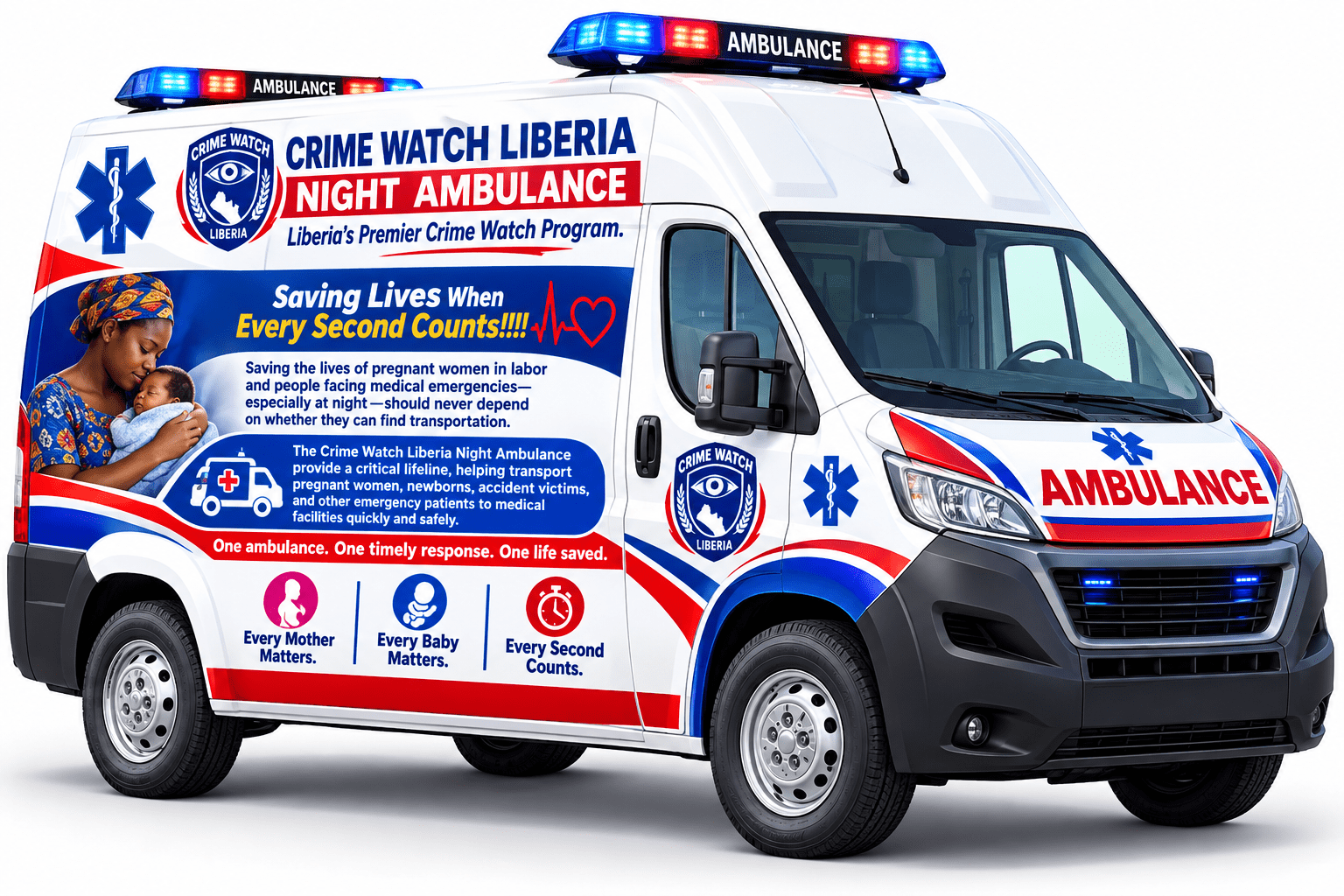
In response to this growing concern, Crime Watch Liberia is calling on the Government of President Joseph N. Boakai, humanitarian organizations, international partners, philanthropists, churches, businesses and other well-meaning Liberians to urgently support the establishment of a Crime Watch Liberia Night Ambulance Service.
The proposed ambulance would not only respond to pregnant women in labor but could also assist victims of accidents, medical emergencies, injuries, elderly people and other residents who require urgent nighttime transportation to health facilities.
A dedicated nighttime ambulance could mean the difference between life and death.
It could mean a pregnant mother reaching a hospital before complications become fatal.
It could mean an unborn baby receiving the emergency care needed to survive.
And it could mean a family receiving help before it is too late.
A Call To Save Lives
The Marthaline Cooper incident should not simply become another heartbreaking story that disappears from public attention.
It should become a wake-up call.
No pregnant woman should be forced to lie on the roadside in the middle of the night while her family desperately searches for transportation.
No mother should have to give birth on bare ground because an ambulance is unavailable.
And no family should have to mourn the loss of an unborn child simply because emergency transportation could not reach them in time.
Crime Watch Liberia believes that a Night Ambulance is not a luxury—it is a life-saving necessity.
The organization therefore appeals to the Boakai’s government and humanitarian partners to join hands with Crime Watch Liberia and provide the resources needed to acquire and operate a dedicated Crime Watch Liberia Night Ambulance.
One ambulance could save a mother.
One ambulance could save a baby.
One ambulance could save an entire family from a lifetime of grief.
The time to act is now—before another mother cries for help in the darkness, and before another unborn baby becomes a preventable statistic.
Comments are closed.