

3 Mins Read
ADNews-Monrovia, Liberia: The legal department of the state has raised strong legal and institutional objections to the Legislature’s passage of a revised Port Authority Act, warning that the law fails to address key concerns outlined by President Joseph Nyumah Boakai Sr. and could undermine the country’s constitutional balance of power.
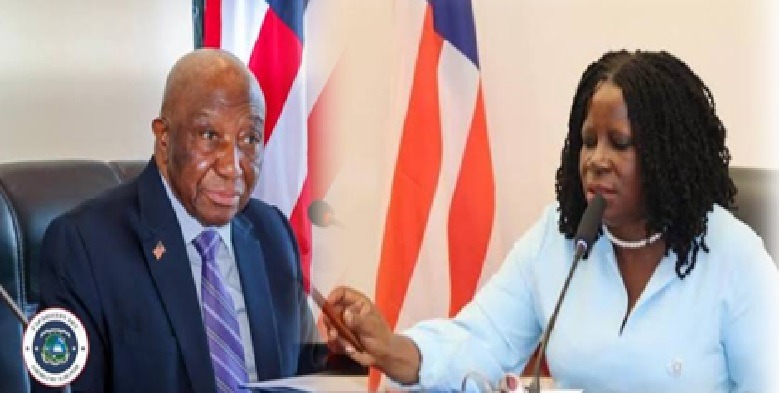
In a formal legal opinion submitted to the Executive, Liberia’s Minister of Justice and Attorney General, Cllr. Natu Oswald Tweh Sr., said the revised legislation weakens existing maritime governance institutions and risks setting a precedent that could strain relations between the Executive and Legislature. He cautioned that the law, as passed, carries significant political and institutional implications for Liberia’s system of governance.
Tweh criticized lawmakers for advancing major reforms in the port sector without substantive consultation with the Executive, describing the process as a departure from coordinated governance. He warned that unilateral legislative action on far-reaching institutional restructuring could foster an adversarial dynamic between the branches of government.
“Liberians expect collaborative governance, not institutional conflict,” the Justice Minister noted, adding that persistent public disagreements over major reforms could erode confidence in the government’s ability to function effectively.
The Attorney General also faulted the structural design of the revised Act, describing it as a hybrid governance framework that borrows elements from multiple international port management models without clearly adopting any established or proven system. While acknowledging that innovation in public administration is not inherently problematic, Tweh said such an approach requires strong justification and detailed implementation planning, which he found lacking in the legislation.
According to the Justice Minister, the proposed framework has no clear precedent among successful maritime administrations worldwide, raising questions about its long-term viability and effectiveness.
President Boakai previously vetoed the original Port Authority Act, citing multiple legal and policy concerns. However, Tweh concluded that the revised version does little to resolve those objections.
Among the unresolved issues is the weakening of the Liberia Maritime Authority (LiMA). The President had warned that transferring core regulatory responsibilities to a new agency would diminish LiMA’s role. Tweh said Section 720(1) of the revised Act still reallocates key regulatory functions, effectively ignoring that concern.
Another objection involved provisions granting the new agency authority to enforce maritime regulations, including inspection and supervision of seacraft. Tweh noted that Section 506 of the revised Act continues to assign those powers, despite the earlier veto.
The Attorney General also highlighted continued concerns over financing, pointing to Section 406 of the revised Act, which allocates 10 percent of all port revenues to fund the new agency. President Boakai had objected to the scope and fiscal implications of that provision, but it remains unchanged, Tweh said.
Taken together, the Justice Minister’s legal assessment suggests that the revised Port Authority Act remains burdened by constitutional, institutional, and fiscal deficiencies. He urged lawmakers to reconsider the legislation with greater attention to the separation of powers, administrative efficiency, and respect for executive authority.
As debate intensifies, the port reform dispute has emerged as a broader test of Liberia’s commitment to the rule of law and effective democratic governance.
source IPNews
Comments are closed.