
Government Targets Over 1,000 Hectares of Rice Cultivation in 2027
Farm Development, Technical Assistance and IFAD-Backed Road Rehabilitation to Boost Agricultural Production in Lofa

10 Mins Read
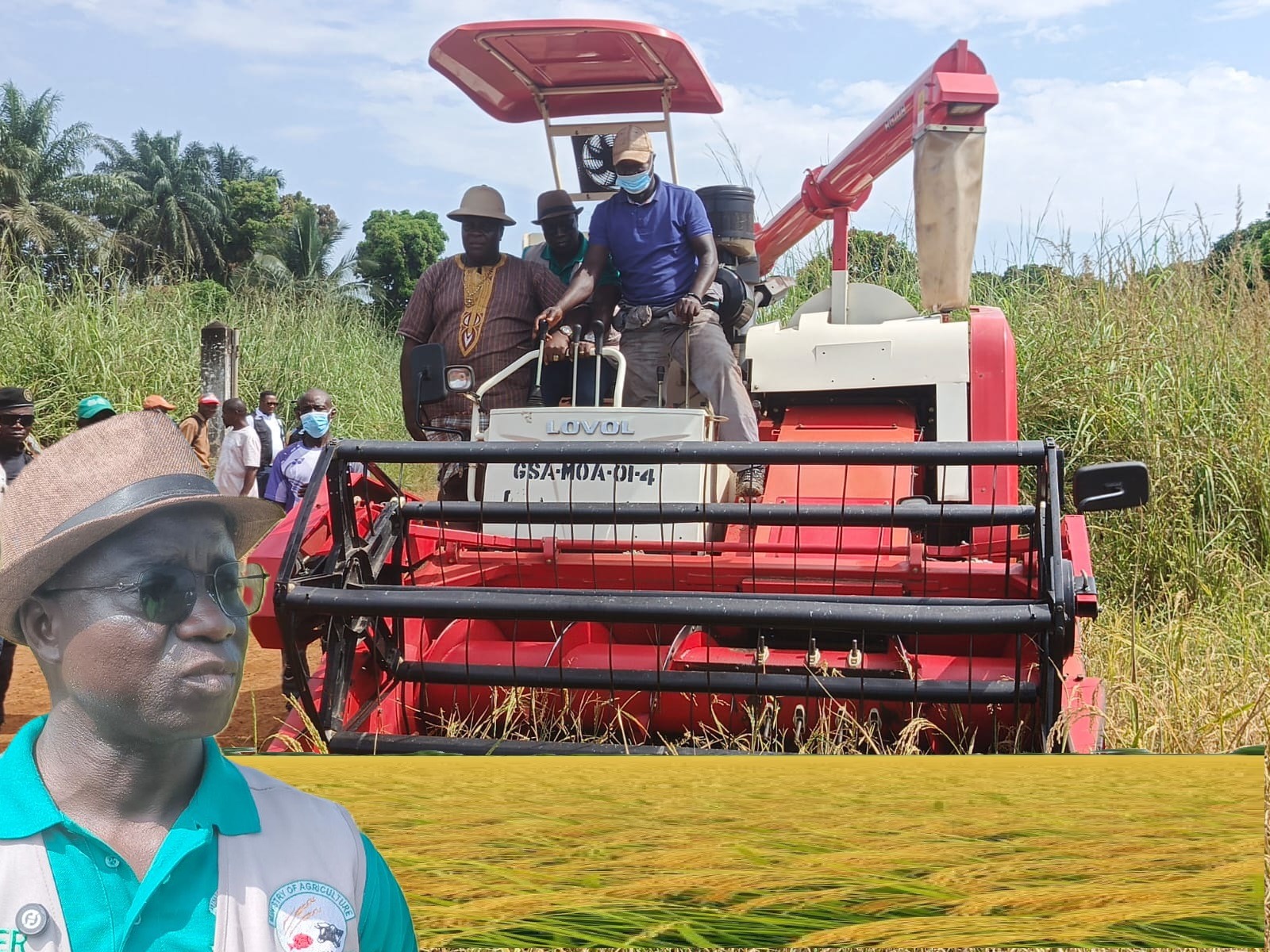
ADNews- Lofa County, Liberia: The Government of Liberia has announced plans to expand rice cultivation in Lofa County to more than 1,000 hectares in 2027, as part of efforts to increase domestic food production and reduce the country’s dependence on imported rice.
By Junior B. Kesselee and Y. Bestman Yarkpawolo
The Ministry of Agriculture is working with the Selma Agriculture Development Corporation to achieve the target through agricultural investment, technical assistance and improved rural road infrastructure.
Agriculture Minister Dr. J. Alexander Nuetah announced the expansion plan on November 20, 2026, during the official launch of the harvest at the company’s lowland rice farm in Lisco Town, Lofa County.
The minister said the government has provided substantial support to the company’s farming operations, including land development, agricultural inputs and technical assistance aimed at increasing production capacity.
The farm currently covers approximately 927 acres, equivalent to about 375 hectares, dedicated to rice cultivation. According to the company’s owner, John Selmah, an additional 60 hectares were cultivated with beans and corn during the current farming season.
The ceremony brought together representatives of the International Fund for Agricultural Development (IFAD), the Smallholder Agriculture Transformation and Agribusiness Revitalization Project (STAR-P), as well as residents and representatives of several towns and villages in the region.
Speaking at the occasion, Minister Nuetah expressed satisfaction with the level of agricultural production at the facility but emphasized the need for Liberia to do more to strengthen its agricultural sector and reduce reliance on imported food.
He disclosed that the Ministry had supported the company’s operations through land development, the provision of agricultural inputs and technical assistance from its project teams.
“We provided support in land development. We also provided some inputs directly from the Ministry, along with assistance from our project teams that are working with him,” Minister Nuetah said.
According to the minister, the government’s agricultural strategy is moving beyond supporting individual farming initiatives to attracting substantial investments capable of increasing production and transforming the sector.
As part of the strategy, he said he had instructed the Lofa County Agriculture Team to identify and survey suitable land for large-scale agricultural production.
He also disclosed that agricultural coordinators across the country had been directed to identify areas with potential for increased rice cultivation.
Nuetah said his five-year vision is to see more locally produced rice on the Liberian market and the emergence of additional successful agricultural enterprises similar to the Selma operation.
The Ministry’s intervention in Lofa County forms part of a broader national agricultural investment agenda aimed at strengthening food production and attracting private-sector participation.
In October 2026, Minister Nuetah presented an estimated US$370 million agricultural investment portfolio at the Food and Agriculture Organization’s Hand-in-Hand Investment Forum in Rome, Italy.
The portfolio identified approximately US$243 million in proposed investment opportunities for Liberia’s rice value chain, alongside opportunities in cocoa, cassava and maize production.
The minister also disclosed that Liberia has more than 600,000 hectares of potentially irrigable land, creating opportunities for expanded irrigation, mechanized farming, modern rice milling facilities and improved market development.
He further indicated that he was seeking US$69 million for the Ministry of Agriculture in the 2027 National Budget to strengthen direct support to farmers and expand the Ministry’s technical capacity across the country.
Nuetah disclosed in October that Liberia requires approximately 436 agricultural technicians to adequately serve its 109 agricultural districts. However, the country currently has only 138, leaving a significant gap in frontline agricultural extension services.
The renewed government focus on rice production comes amid Liberia’s continued struggle to meet domestic consumption demands.
The Food and Agriculture Organization estimates the country’s annual rice demand at approximately 650,000 metric tonnes, with average per-capita consumption of about 133 kilograms annually.
In an October 2026 statement, the Ministry of Agriculture said domestic rice production accounts for approximately 35 to 40 percent of national demand, while rice imports exceeded US$75 million during the first half of the year.
Against this background, the approximately 375-hectare Selma rice farm represents a contribution to the country’s domestic production capacity.
Based on the national paddy-yield range of 1.1 to 2.0 metric tonnes per hectare presented in Liberia’s 2026 agricultural investment materials, the farm could produce an estimated 413 to 750 metric tonnes of paddy rice from one harvest.
At an estimated milling recovery rate of 60 to 65 percent, the projected output could translate into approximately 248 to 488 metric tonnes of milled rice.
Although these figures are estimates rather than the company’s officially reported harvest results, the potential output would represent approximately 0.04 to 0.08 percent of Liberia’s estimated annual rice demand.
At the national consumption rate, the projected quantity could meet the annual rice needs of approximately 1,900 to 3,700 people.
Meanwhile, the government’s agricultural intervention in Lofa County extends beyond farm development and technical assistance to include rural road rehabilitation aimed at connecting farming communities to markets.
Through the Ministry of Agriculture, the government launched the rehabilitation and reconstruction of 18 rural road lots covering more than 144 kilometres of feeder roads across six districts in Lofa County in November 2025.
The intervention is being implemented under the Tree Crops Extension Project II (TCEP II), with financial support from the International Fund for Agricultural Development.
The road rehabilitation programme covers communities in Salayea, Voinjama, Kolahun, Zorzor, Quardu Gboni and Foya districts.
According to the Ministry, the project is intended to reduce transportation costs and travel time, minimize post-harvest losses and improve farmers’ access to markets and agricultural services.
The 6.1-kilometre stretch from Voinjama Highway to Sekemai Town was awarded to Liberia Quang Sheng Group, while BK Enterprise was contracted to work on the 10-kilometre Sekemai Town-to-Kpadeh Village section.
Cross Road Enterprise was assigned the 10-kilometre Kpadeh Village-to-Kpotomai Town section, while ELITE Contractor and Global Services received the contract for the 9.5-kilometre Zeayorzu Town-to-Lisco Town road section.
At the launch of the wider road rehabilitation programme on November 15, 2025, the Ministry announced that the 18 road lots were expected to be completed within ten months.
However, road construction activities along the Voinjama-Lisco corridor were still ongoing in November 2026.
For Selmah, improved road access has been an important development for the company’s agricultural operations, which previously faced serious transportation challenges.
He disclosed that poor road conditions had resulted in the destruction of two tractors and the loss of more than 250 bags of fertilizer while being transported to the farming site.
“This road was a serious disaster for us. We lost two tractors and more than 250 bags of fertilizer after they were dumped into the water,” Selmah said.
He explained that the Ministry of Agriculture’s intervention, working with its partners, has helped reduce transportation costs and travel time, making it easier to transport farming equipment and agricultural inputs to the production site.
Selmah also credited the Ministry for providing technical assistance that has contributed to the company’s farming activities.
Looking ahead, he said the company intends to work with the Ministry to cultivate more land in 2027, in line with the government’s target of expanding rice production beyond 1,000 hectares.
He further disclosed plans to extend the company’s agricultural operations to other counties, including Grand Gedeh.
According to Selmah, the company’s locally produced rice is already available on the Liberian market. He encouraged citizens to patronize locally produced food as a way of supporting domestic farmers and strengthening national food production.
Beyond the agricultural benefits, residents of surrounding communities say improved road access is providing relief to commuters who previously struggled with high transportation costs and difficult travel conditions.
The landlord of Kpademai Town, Gayduogba Akoi, praised the government’s intervention, particularly the road rehabilitation, which he described as a significant improvement for residents in the area.
“Getting a road to my home was very difficult. But this time, the government has made it possible for us to have road access,” Akoi said.
He disclosed that transportation fares from Lisco to Voinjama, which previously cost approximately LRD$1,500, have declined to around LRD$1,000 following the road improvements.
“For the first time, if a motorcycle carried an individual from here to Voinjama, it cost LRD$1,500. Together with your load, it was very difficult for us. Today, at least LRD$1,000 can take you there,” Akoi added.
He said the intervention has reduced transportation expenses and made movement easier for residents, while calling on the government to sustain its support for agriculture and rural infrastructure.
Another resident of Kpademai Town, Mulbahyoko Kwa, also commended the government’s agricultural initiatives and expressed satisfaction with the road improvements undertaken by the Ministry of Agriculture and its partners.
The government’s interventions in Lofa County underscore the importance of linking agricultural investment with rural infrastructure development.
However, translating the ongoing investments and expansion commitments into a significant increase in Liberia’s national rice supply will require sustained government funding, improved access to quality agricultural inputs, adequate technical support, efficient processing facilities and reliable market connections.
As Liberia continues to spend millions of dollars importing rice, the planned expansion of the Selma Agriculture Development Corporation and other agricultural enterprises could contribute to the country’s broader efforts to strengthen local food production and improve food security.
Comments are closed.