

3 Mins Read
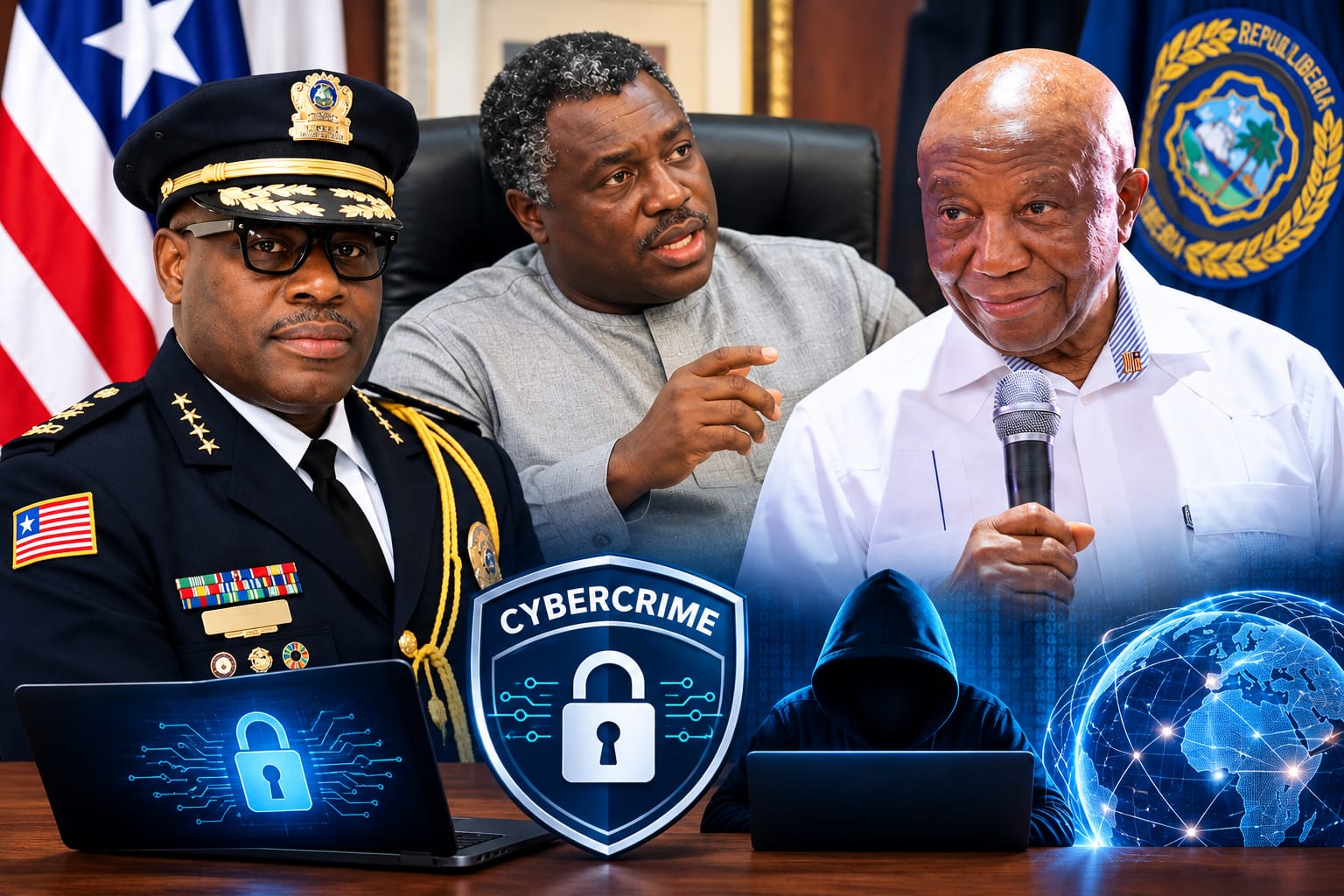
ADNews-Monrovia,Liberia: Liberia’s National Police Inspector General, Gregory O. W. Coleman, has commenced the enforcement of the new cyber law intended to limit certain aspects of “Free Expression” that might create political instability.
America, the father of modern democracy, uses cartoon illustrations to negatively portray its leaders in every form and manner that has never been labelled as cybercrime.
Now, with the invention of Artificial Intelligence (AI) tools, the negative portrayal of global leaders has significantly increased and is acceptable in line with fundamental principles of human rights.
However, Liberia’s current government under the leadership of President Joseph Nyuma Boakai, a nation regarded as the first independent state of Africa, the home of the black race, has introduced the new cyber law, which many characterize as an instrument to muzzle free speech, free expression, and fundamental human rights.
Cyber law is the legal framework that governs the use of computers, digital networks, and the internet to protect users and secure data.
Recently, a young Liberian, Jerry Nyantee Wroto, was arrested under the order of Coleman for allegedly portraying the Liberian Vice President Jeremiah Kpah Koung half-naked while at the foreign Airport, subjected to a search.
Gregory’s action met critical public resistance, as many characterized it as a calculated attempt by the government to silence critical voices and introduce a tyrannical regime where citizens will lose their fundamental human rights.
Following heavy public reactions to the arrest, Vice President Jeremiah Kpan Koung reluctantly addressed the matter and said he had received several calls concerning the case.
According to Koung, who is currently out of the country attending a national function, he contacted Inspector General Coleman, who confirmed that the arrest had been made under Liberia’s Cybercrime Law.
Koung said he respected the authority of the police and its responsibility to enforce the law but made clear that he did not want to press charges against Wroto over the content and subsequently requested the young man’s immediate release.
“Public office comes with criticism, ridicule and sometimes deliberate provocation. I understand that reality, and I am built for it,” Koung said.
He added that while laws must protect citizens, public officials must also demonstrate tolerance, restraint and compassion.
“Again, this is part of the package,” the Vice President said.
The Wroto case has opened a wider national conversation about the limits of online expression and the responsibilities of government in enforcing Liberia’s new Cybercrime Law.
For Liberia, the challenge remains finding a balance between protecting citizens from genuine cyber abuse and ensuring that the enforcement of cybercrime legislation does not unnecessarily restrict legitimate criticism and freedom of expression.
The controversy surrounding Wroto’s arrest has consequently placed the implementation of the new cyber law under increased public scrutiny.
Comments are closed.