

4 Mins Read
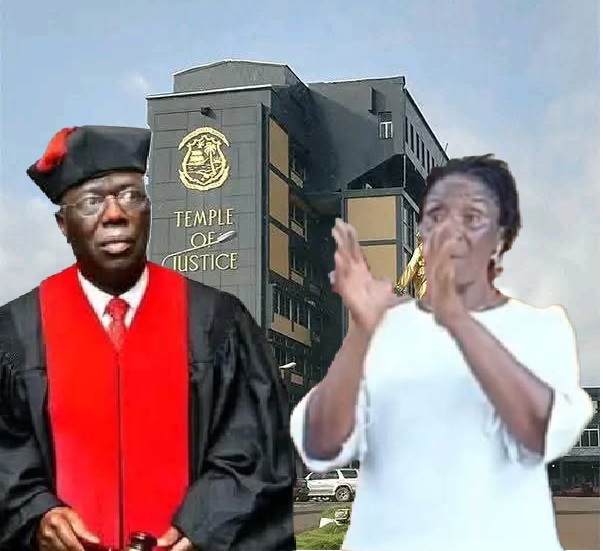
ADNews-Monrovia, Liberia: A growing controversy has gripped Liberia’s Judiciary following the recent appointment of Chief Justice Yormie Gbeisay’s son as an Associate Magistrate, a move that has drawn criticism from within the judicial ranks and prompted a strong public defense from the Chief Justice himself.
By Benjamin Quaye Johnson benjaminqjohnson@gmail.com | +231770980259
Addressing a gathering of judges in Lofa County, Chief Justice Gbeisay staunchly defended both the appointment process and his son,s qualification , describing criticisms from trial judges as “legally baseless.”
He emphasized that his son is a Liberian citizen and a current student at the Louis Arthur Grimes School of Law, suggesting that these credentials satisfy the requirements for judicial appointment at the magistrate level.
However, Liberia’s Code of Conduct section 9.7 on Nepotism says, “A Public Official may not appoint, employ, promote, advance, or advocate for appointment, employment, promotion, or advancement, in a civilian or military position in the agency or branch of Government in which he or she is serving or has jurisdiction or control, any individual who is a Relative, as defined in Section 1.3.21 of this Code. An individual who is a Relative of a Public Official may not be appointed, employed, promoted, or advanced in or to a military or civilian position in an agency or branch of Government if such appointment, employment, promotion, or advancement has been influenced or advocated by the Public official. Any such appointment upon investigation shall be declared null and void. Upon being declared guilty in accordance with due process, the appointing authority shall be subject to dismissal, suspension, or impeachment in accordance with due process.
The Chief Justice’s comments were in response to a formal communication from Judge Nancy F. Sammy, President of the National Association of Trial Judges of Liberia (NATJL), who had earlier raised concerns about the qualifications of eight newly appointed Associate Magistrates, including the Chief Justice’s son, based on complaints received from fellow magistrates.
“I recommended my son to the President, and if the President saw it fit to nominate him, I see nothing wrong with that, ” Chief Justice Yormie Gbeisay asserted.
In an emotional and forthright statement at the same event, Judge Sammy clarified her intent, stating that her letter was not an attack but a request for the Chief Justice’s intervention to address the allegations presented by concerned magistrates.
“We are talking about the integrity of the Judiciary, Your Honor,” she said. “My letter was not a bad letter. I was simply seeking your intervention to address the allegations raised by the Associate Magistrates.”
Judge Sammy expressed disappointment over the unauthorized public release of her private communication, which she says unnecessarily escalated the issue and created a false impression of division within the Judiciary.
“I even wrote to the Associate Magistrates, telling them: You can’t be doing this to me after you complained to me and then allowed the communication to leak,” she explained. “But I want to be clear: I had nothing to do with the leakage… I would not be so unprofessional as to send you a letter and then release it on social media.”
Chief Justice Gbeisay, during his remarks, invoked the legal principle that “those who come to equity must come with clean hands,” and alluded to a potential conflict of interest involving Judge Sammy’s husband, who serves as an Assistant Minister in the Liberian government.
Judge Sammy, however, responded firmly, stating that her husband has served in that position for 18 years, well before their marriage and her elevation to the bench and that his role bears no connection to her judicial duties.
“His job has nothing to do with the work I am doing now. So, I do not see any conflict of interest,” she said.
The controversy has highlighted underlying tensions surrounding transparency, meritocracy, and the credibility of judicial appointments in Liberia.
As the Judiciary seeks to navigate this controversy, many are calling for clearer appointment guidelines, greater transparency, and a reaffirmed commitment to upholding the rule of law free from the appearance of personal or political influence.
Comments are closed.