

4 Mins Read
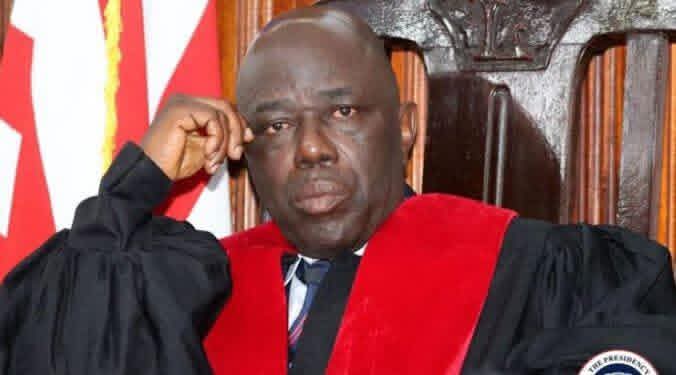
ADNews-Monrovia, Liberia: In a bold and unprecedented move, Chief Justice Yamie Quiqui Gbeisay has called on the General Auditing Commission (GAC) to conduct a full skill audit of the administration of his immediate predecessor, former Chief Justice Sie-A-Nyene Yuoh, sending shockwaves through Liberia’s judicial and political establishments.
By Benjamin Quaye Johnson /benjaminqjohnson@gmail.com
Delivering his opening address on Monday, October 13, 2025, at the commencement of the October Term of the Supreme Court, Chief Justice Gbeisay made it clear that his administration is committed to transparency, accountability, and a comprehensive overhaul of Liberia’s judicial system.
“Far from witch-hunting, but consistent with promoting the integrity of the judiciary and in line with international best practice, this administration on September 4, 2025, invited the GAC to audit the stewardship of the past administration,” he stated firmly.
His call, issued from the nation’s highest judicial platform, reinforces growing public sentiment that the judiciary has historically failed to regulate itself, and in some cases, may have facilitated unethical practices through negligence or complicity.
Chief Justice Gbeisay did not limit his remarks to calls for retrospective accountability. He outlined a sweeping reform agenda targeting systemic corruption, inefficiency, and unethical conduct within the judiciary.
A cornerstone of this reform is the establishment of the Judicial Monitoring, Evaluation and Accountability Division (JME&ACD) a unit he described as a powerful “judicial police” force. The division will be tasked with conducting surprise inspections, monitoring court staff, and even recording or photographing court activities when necessary.
“Corruption must go, or corrupt people must go!” Gbeisay declared, echoing the frustration of a public long disillusioned with a judiciary often seen as inaccessible, slow, and compromised.
The JME&ACD will be empowered to observe courtroom proceedings, inspect judges’ chambers, and review court records to ensure that all fines, fees, and court costs are being lawfully collected and properly accounted for.
In a further push for transparency, all judges and magistrates have been given 30 days to declare their assets or face “administrative consequences” a move aimed at exposing unexplained wealth and curbing financial opacity in the judiciary.
While Chief Justice Gbeisay praised recent developments such as the renovation of several court buildings and the appointment of magistrates, he emphasized that low- and mid-level court employees, including clerks, sheriffs, bailiffs, and recorders, would no longer operate without oversight.
To address misconduct among these ranks, he announced the establishment of a Permanent Judicial Complaints Committee to investigate complaints specifically against judiciary staff filling what he called a long-standing gap in the justice system’s internal disciplinary framework.
“There are channels for redress against judges and lawyers, but none for judiciary staff. That changes now,” Gbeisay declared.
The committee will be equipped with two mobile phones and four dedicated contact numbers, prominently displayed at court facilities nationwide, allowing aggrieved lawyers and litigants to report incidents of misconduct via SMS or WhatsApp in real time.
Gbeisay’s remarks follow a recent tour of Lofa, Bong, and Nimba counties, where he met with legal professionals to reinforce his policy of discipline, integrity, and zero tolerance for corruption. During these engagements, he condemned the “commercialization of the court process” referring to unauthorized fees often charged by judicial staff and promised strict action against violators.
Chief Justice Gbeisay also used his address to highlight infrastructure progress, including:
The Fourth Judicial Circuit Court Complex in Harper, Maryland County, is now 70% complete, and we have completed and dedication of new magisterial courts in Brewerville and Gardnersville
However, he stressed that these achievements are only part of a broader vision.
He expressed disappointment that the Supreme Court of Liberia still operates from a building constructed in the 1960s, which he described as inadequate for modern judicial operations.
“We are not satisfied, and we will not be satisfied until a modern Supreme Court building is constructed,” he asserted.
He revealed plans to present an architectural design for a new Supreme Court complex to the President, as part of the judiciary’s five-year strategic plan.
Chief Justice Gbeisay’s address was forceful, sweeping, and unprecedented in tone.
He has issued a direct challenge to entrenched interests, set clear performance benchmarks, and signaled a new era of accountability in Liberia’s judiciary.
Comments are closed.