


12 Mins Read
RESEARCH ARTICLE
The Global Economic Cost of American Militarism
An Analysis of the Economic Ripple Effects of the 2026 Israel-American Invasion of Iran
Jusu Kamara
Senior Year Student, International Relations
Cuttington University of Graduate and Professional Studies
& International Development, African Methodist Episcopal University
Social Democrat | Political Activist | Retired Youth and Student Leader, Liberia
Submitted: March 12, 2026 · Day 18 of the Israel-American Invasion of Iran
- INTRODUCTION
On February 28, 2026, the United States and Israel launched a coordinated military campaign against Iran, codenamed Operation Epic Fury, assassinating Supreme Leader Ali Khamenei and targeting military and nuclear infrastructure across the country.1 As the world enters Day 12 of this conflict, the consequences of this act of military adventurism have long escaped the battlefield. They are now registered on commodity exchanges, in the budgets of fragile states, in the grocery bills of ordinary families across Asia and Africa, and in the forward projections of the world’s most credible economic institutions.
For a student of International Relations and International Development, and for a citizen of a developing nation whose people bear the costs of decisions made in Washington without their voice or consent, this conflict demands rigorous, evidence-based analysis. The central argument of this paper is direct: the United States, through its unilateral resort to military force, has produced an energy, food, and financial shock that is disproportionately devastating to the Global South while the architects of the war insulate themselves from its most catastrophic consequences.
- THE ENERGY SHOCK AND THE STRAIT OF HORMUZ
The most immediate economic consequence of the invasion has been a severe disruption to global energy markets, triggered by Iran’s effective closure of the Strait of Hormuz, the narrow waterway merely 21 nautical miles wide at its narrowest point, through which approximately one-fifth of the world’s daily oil supply and twenty percent of global liquefied natural gas (LNG) transits.2 According to Jorge Leon, Head of Geopolitical Analysis at Rystad Energy, the Hormuz disruption represented the effective halt of some 15 million barrels per day of crude oil from reaching global markets.3
The price response was immediate and dramatic: Brent crude surged from under $70 per barrel on February 27 to a peak of nearly $120 per barrel by early the following week, the first time oil had breached the $100 threshold since Russia’s 2022 invasion of Ukraine.4 By Day 12, prices had receded to approximately $90 per barrel, still representing an increase in excess of 25 percent from pre-war levels.5
The closure of the Strait of Hormuz had long been identified as the scenario that most deterred Washington from authorizing a strike on Iran. That deterrent has now failed, and the world is living with the consequences.
Maurice Obstfeld, Peterson Institute for International Economics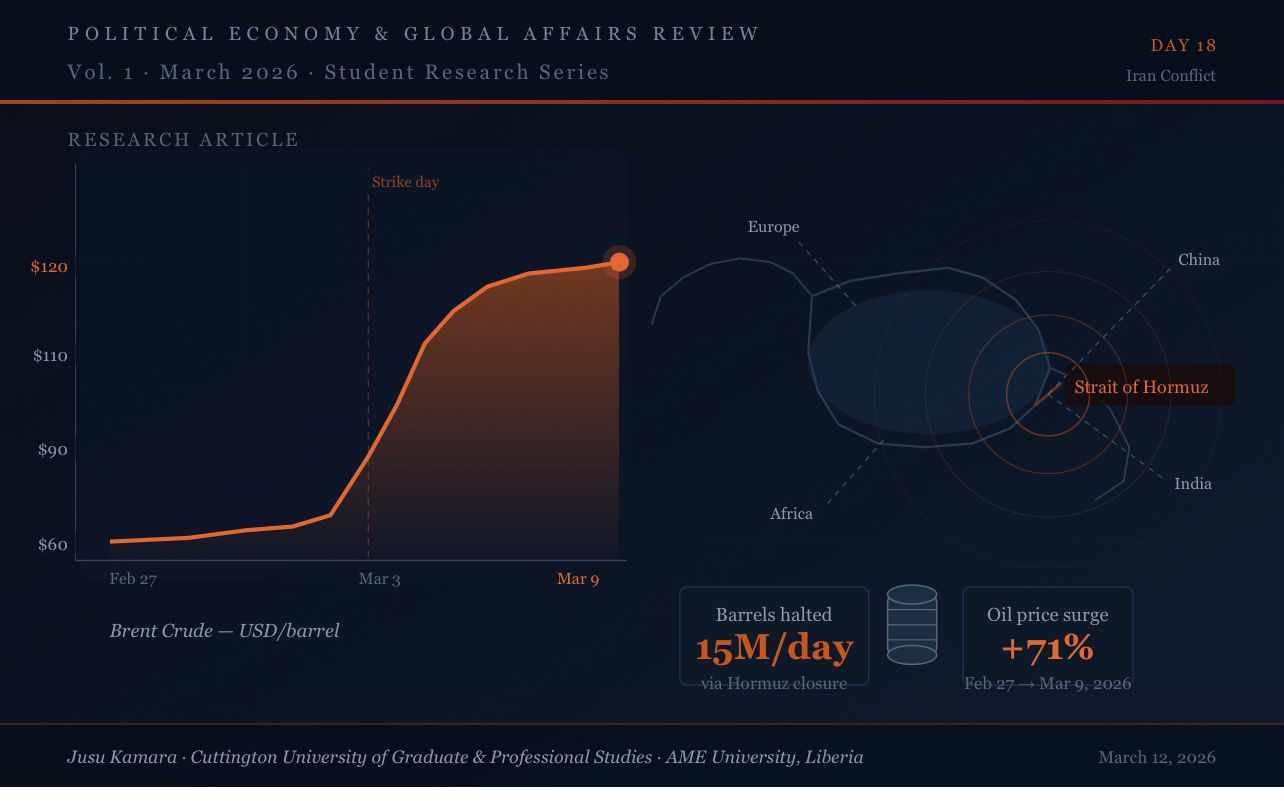
Compounding the primary shock, Qatar declared force majeure on its LNG exports following Iranian drone attacks on its facilities, and Saudi Aramco’s Ras Tanura crude export terminal, among the largest in the world, was forced to close.7 Collectively, Iraq, Kuwait, Saudi Arabia, and the UAE cut oil production by a reported 6.7 million barrels per day by March 10 alone, as storage capacity in the Gulf filled rapidly with oil that had nowhere to go.8 The International Monetary Fund has long estimated that every sustained ten percent rise in oil prices produces a 0.4 percent rise in global inflation and a 0.15 percent reduction in global economic growth,9 a formula whose implications, at the price surges presently observed, are profoundly alarming.
III. CASCADING DISRUPTIONS: FOOD, SUPPLY CHAINS, AND FINANCIAL MARKETS
The economic disruptions generated by this war have not remained confined to the energy sector. Signs of strain are already visible across the carefully orchestrated arteries of global trade: from rice exports stranded at ports in India to surging fertilizer prices critical to agricultural production worldwide.10 Satish Goel, President of the All India Rice Exporters’ Association, confirmed that more than 400,000 metric tons of basmati rice destined for export had been halted at Indian ports or in transit, given that approximately 75 percent of India’s annual basmati rice exports flow through Middle Eastern shipping lanes.11 The New Lines Institute further notes that Gulf states account for 20 to 30 percent of global LNG exports and that the Strait of Hormuz is critical to the movement of fertilizer precursors, disrupting agricultural supply chains globally and threatening food security in import-dependent nations.12
Financial markets have responded with equal alarm. Japan’s Nikkei 225 fell more than five percent; South Korea’s KOSPI dropped six percent; European indices registered losses of two to three percent; and US futures fell sharply as investors priced in supply disruption risk.13 Goldman Sachs estimated that if oil prices remain at current levels for several months, US consumer price inflation could rise from 2.4 percent in January 2026 to 3 percent by year’s end, a trajectory that would make Federal Reserve interest rate cuts substantially more difficult to deliver.14 For developing economies, which lack the monetary policy depth of the United States, the bind is even more acute: rate hikes suppress growth while inaction entrenches inflation. Capital Economics concluded that most Asian economies face an additional half percentage point of inflation at current crude price levels, while Europe faces eurozone contraction in the second quarter of 2026.15
- THE BURDEN ON THE GLOBAL SOUTH
No dimension of this crisis more clearly reveals the inequity of American militarism than its impact on the Global South. Egypt’s President Abdel Fattah el-Sisi declared his country’s economy to be in a state of near-emergency, citing accelerating inflation.16 Djibouti’s Finance Minister, Ilyas M. Dawaleh, issued a formal warning that the conflict would bring severe economic consequences for developing countries, noting that small states dependent on maritime trade risk being pulled into deeper economic uncertainty as the shocks ripple across Africa.17 Chatham House identifies Pakistan, Egypt, and Tunisia as especially vulnerable, given extensive energy subsidies and fragile public finances, nations that face the compound pressure of rising import costs, currency depreciation, and deteriorating fiscal positions simultaneously.18
India, which imports more than 80 percent of its crude oil with nearly half from the Gulf, faces immediate pressure on its exchange rate and trade balance.19 China, the world’s largest oil importer, sources close to half of its energy from the Gulf and purchased approximately 90 percent of Iran’s oil exports prior to the conflict.20 The broader lesson is structural: in the global energy architecture, oil is priced in dollars, meaning that rising prices force energy-importing nations in the Global South to mobilize ever-larger volumes of their domestic currency to purchase the same quantities of energy, deepening current account deficits, stoking inflation, and concentrating the costs of a war they had no hand in initiating.
- AMERICA’S RESPONSIBILITY AND THE ILLUSION OF CONTAINMENT
The United States bears direct and unambiguous responsibility for initiating this crisis. Operation Epic Fury was authorized by President Donald Trump at the behest of Israel and Saudi Arabia, notwithstanding credible evidence that diplomacy remained a viable alternative in the days before the strikes were launched.21 When confronted with the economic consequences of his decision, President Trump reportedly described rising oil prices as a small price to pay for safety and peace,22 a formulation that encapsulates precisely the indifference this analysis seeks to name. It is not, in fact, a small price. It is a catastrophic price, and it is being paid not by the administration that imposed it, but by Filipino motorcycle drivers queuing at petrol stations, Indian farmers watching rice exports rot at ports, Egyptian families confronting food price spirals, and Djiboutian traders watching their trade routes collapse.
Chatham House notes, with considerable irony, that the United States is among the few large economies likely to benefit from elevated oil prices through its own domestic production, reinforcing an existing structural asymmetry in which the hegemon that wages war absorbs gains from the resulting price shock while exporting the losses to energy-importing developing nations.23 The Qatari Energy Minister, Saad al-Kaabi, warned the Financial Times that prices could reach $150 per barrel if disruptions persist and that additional force majeure declarations across the region were imminent.24 Chatham House projects that a sustained conflict scenario could see oil prices reach $130 per barrel, producing a eurozone contraction and a meaningful slowdown in US growth, scenarios that, under present conditions, are not hypothetical but increasingly probable.25
- CONCLUSION
Twelve days into the Israel-American invasion of Iran, the economic verdict is already legible in the data. The Strait of Hormuz closure, the fertilizer and food supply disruptions, the collapse of Asian and European equity markets, the inflationary pressures bearing down on fragile states, and the impossible bind facing developing economy central banks are not unforeseen side effects. They are the predictable and preventable consequences of a hegemon’s unilateral resort to force.
The IMF, Chatham House, Capital Economics, Goldman Sachs, Rystad Energy, and the New Lines Institute have each, in their own institutional registers, identified the same causal chain: American military action has produced a global energy shock whose costs are distributed in inverse proportion to responsibility for the decision. This is not simply an economic observation. It is a moral indictment. For emerging scholars of International Relations and International Development, the 2026 Iran war must be studied not only as a case in military strategy, but as a case in political economy, a demonstration that in an interdependent global system, war is never contained, and its costs are always socialized, falling heaviest on those who had the least say in its making.
✦ ✦ ✦
. REFERENCES
- Wikipedia. (2026). “2026 Iran war.” Wikimedia Foundation. Retrieved March 12, 2026, from https://en.wikipedia.org/wiki/2026_Iran_war
- Al Jazeera. (2026, March 10). “How will soaring oil prices caused by Iran war impact food prices?” Al Jazeera. https://www.aljazeera.com/news/2026/3/10/
- Al Jazeera. (2026, March 2). “Oil prices rise sharply after US, Israeli attacks on Iran.” Al Jazeera. https://www.aljazeera.com/news/2026/3/2/
- Al Jazeera. (2026, March 9). “Oil soars past $100 a barrel, stocks plunge as US-Israel war on Iran rages.” Al Jazeera. https://www.aljazeera.com/economy/2026/3/9/
- Al Jazeera. (2026, March 11). “Oil prices swing wildly amid mixed messages over Iran war.” Al Jazeera. https://www.aljazeera.com/economy/2026/3/11/
- Al Jazeera, 2026, March 9 (op. cit.) [citing IMF estimates on oil price transmission].
- CNN Business. (2026, March 5). “Surging energy prices and threats to shipping: How the Middle East war could hurt the global economy.” CNN. https://www.cnn.com/2026/03/05/economy/
- CNN Business, 2026 (op. cit.) [citing Satish Goel, All India Rice Exporters’ Association].
- New Lines Institute. (2026, March 6). “The energy shock: US-Israel war with Iran’s impact on Indian, Chinese, and global economies.” https://newlinesinstitute.org/middle-east-center/the-energy-shock
- Al Jazeera, 2026, March 9 (op. cit.).
. ABOUT THE AUTHOR
Jusu Kamara is a Senior Year student of International Relations at the Cuttington University of Graduate and Professional Studies, and concurrently reads International Development at the African Methodist Episcopal University, both in Liberia. A committed Social Democrat and political activist, Kamara is also a retired youth and student leader whose civic record spans advocacy, policy engagement, and mobilization at the national level. His scholarly interests lie at the intersection of political economy, global governance, and development justice.
He can reached via:
Email: jusukamara100@gmail.com
Cell#: +231777654997/ +231881763773
Comments are closed.