

5 Mins Read
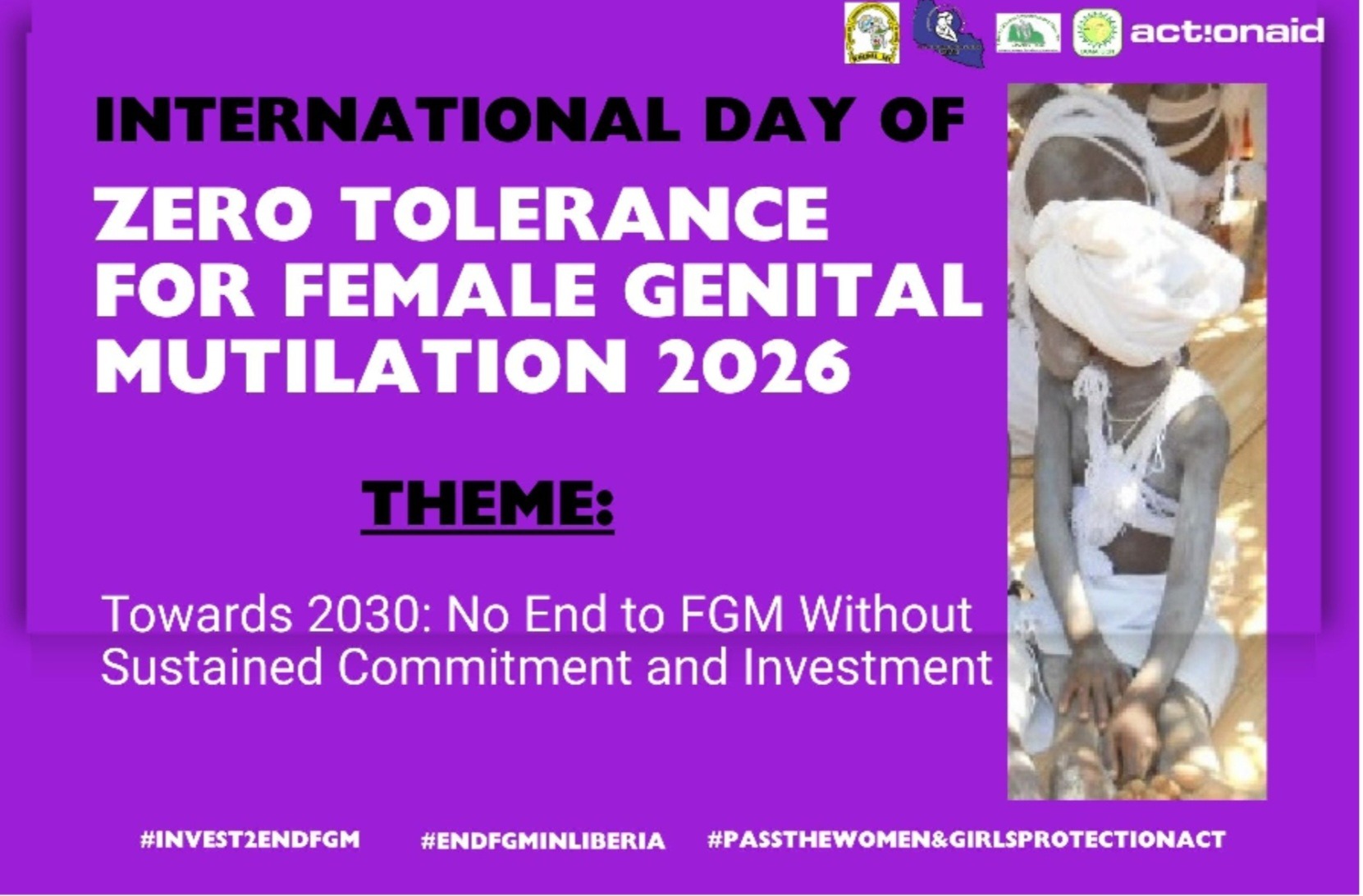
ADNews-Monrovia,Liberia: In commemoration of the 2026 International Day of Zero Tolerance for Female Genital Mutilation (FGM), ActionAid Liberia has released its calendar of activities for this year’s celebration, seeking to step up engagement with key stakeholders and create more community-level awareness on harmful practices.
The days is observed annually on February 6 throughout the month of February to raise awareness about this harmful practice. It aims to highlight the need for global action to eliminate FGM, which is a violation of human rights and has serious health consequences for affected individuals.
The day serves as a reminder of the progress made and the urgent need for continued efforts to end this practice, which affects over 230 million women and girls worldwide according to a Worl Bank report.
This year’s global theme for the observance emphasizes the importance of sustained commitment and investment in eliminating FGM, as the world approaches the 2030 deadline for the Sustainable Development Goal which is “Towards 2030: No End to FGM Without Sustained Commitment and Investment.”
According to ActionAid Liberia’s programs coordinator, Willet Salue, ActionAid commemorates this year’s zero tolerance on FGM with key focus to contribute to the eradication of FGM and other harmful practices by strengthening multi-stakeholder accountability, enhancing more and more public awareness engagement, and promoting the rights, protection, and sexual and reproductive health and rights (SRHR) of women and girls.
She added that key objectives of the observance is to solicit high-level public commitment from government and partners for the passage of the Women and Girls Protection Act (2026), which is currently before the national legislature for passage with an overall aim to facilitate direct policy dialogue between young women advocates and members of the women legislative caucus members as the act is of interest to not just women, but also to Young Urban Women’s Movement.
During the observance, AAL will collaborate with civil society organizations, community-based organizations (CBOs), the government, local and traditional leaders to renew commitment to end harmful practices that often affect Liberian girls and women.
The day is being celebrated alongside other partners, such as the Ministry of Gender Children and social protection, the Women NGO secretariate to support to the national commemoration of the day.
Also, as part of this year’s observance, members of the Young Urban Women’s Movement Liberia’s chapter (YUWML) are expected to hold engagement meeting with members of the women legislative Cacus of the Liberian legislature to give their perspectives on the need to lobby with their counterparts at the legislature in order to pass the Girls and Women Protection Act.
The Women and Girls Protection Act of 2025 is a legislation that is currently before the Liberian National Legislature which was presented by Executive Branch of Government, the office of President Joseph Boakai designed to provide permanent legal protection for women and girls against harmful traditional practices including Female Genital Mutilation (FGM), child marriage, and related violations of human rights and dignity.
The purpose of the Act is to criminalize female genital mutilation (FGM) and other harmful cultural practices that harm the health, rights, and well-being of women and girls and to establish clear penalties for those who perform, facilitate, or assist in acts like FGM and child marriage. it also seeks to provide protection and support for survivors, including access to health care, psychosocial support, and reintegration services.
FGM remains a serious violation of the human rights of women and girls. Globally, more than 230 million women and girls have undergone FGM, according to international estimates. The practice causes severe physical and psychological harm, including chronic pain, excessive bleeding, infections, childbirth complications, trauma, and in some cases death.
In Liberia, FGM is closely linked to initiation into the Sande Society, a traditional women’s secret society. According to the Liberia Demographic and Health Survey (LDHS), approximately 38% of women aged 15–49 have undergone FGM, though prevalence varies significantly across counties and rural communities. While recent advocacy and awareness efforts have contributed to a decline in some areas, the practice remains deeply rooted in cultural norms, social expectations, and gender inequality.
With young people pushing for change, and as ActionAid continues to work with Girls and Boys Forum across several communities, members of the forum will conduct series of community-level outreach and awareness to educate rural residents about the FGM and its effects on girls and women’s heath, their rights, and also about child marriage.
Young activists will use infographics, banners, and in-person mass engagement with community members during the awareness session. The observance will also be led by women, where Women’s Movement Structures will hold convening on district-level town hall meetings.
These districts-level town hall meeting will showcase the Village Saving and Loan Association (VSLA) groups successes, and traditional authorities, as well as local government actors will hold discussions around the draft act, community-level commitments toward alternatives to harmful practices.
Comments are closed.